

Bishop Arts and Kessler Park
Dallas, Texas
JC Carter at Douglas Elliman Real Estate
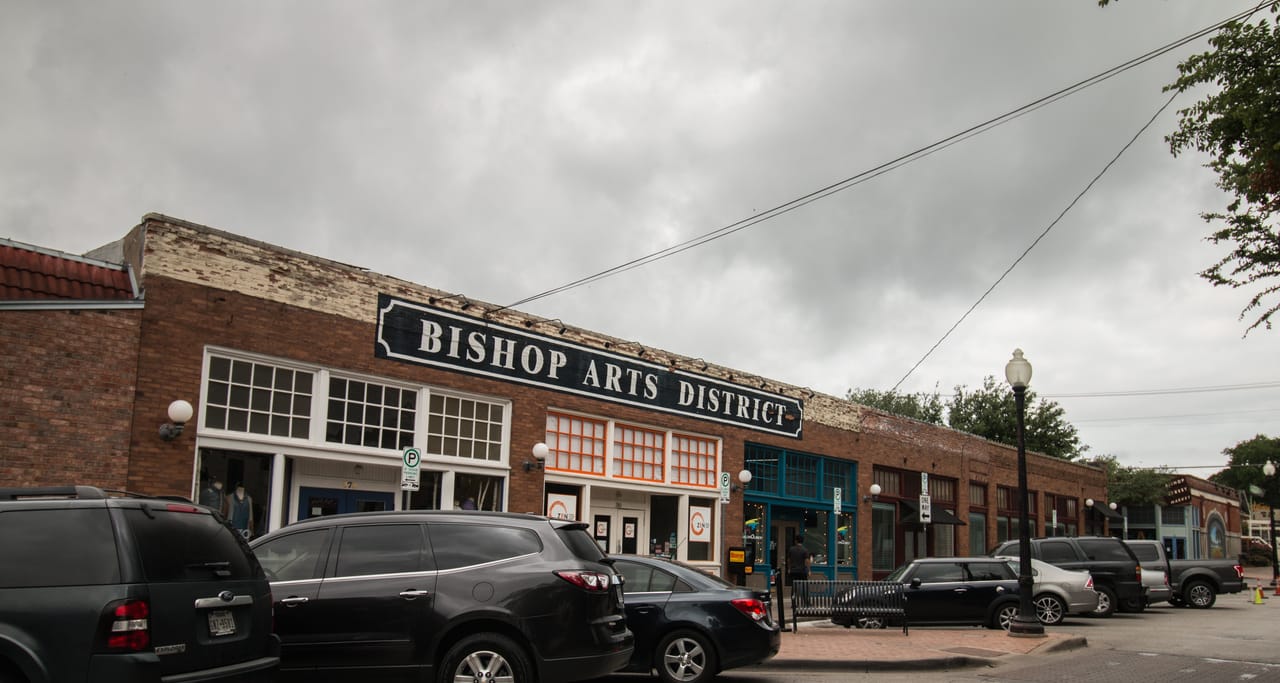
Bishop Avenue storefronts and Kessler’s hills
The Bishop Arts storefronts, Kessler Park’s hills and the historic districts between them.
Bishop Arts and Kessler Park are in North Oak Cliff, across the Trinity River southwest of downtown Dallas. Oak Cliff was its own town, incorporated in 1890, until Dallas annexed it in 1903. Its northern neighborhoods sit on hills with mature trees, on streets laid out in the 1920s.
The Bishop Arts District grew around warehouses and shops near Bishop Avenue and Davis Street in the 1920s. It declined after the mid-1960s, and its revival began in 1984, when Jim Lake started buying the storefronts. Since 2016 the Dallas Streetcar has run from Union Station across the Houston Street Viaduct to Bishop Arts.
Kessler Park, named for the city planner George E. Kessler, climbs west toward Stevens Park Golf Course. Its additions were platted in 1923 and 1924, and Stevens Park Estates followed in 1925. Winnetka Heights, on the National Register since 1983, keeps more than 600 early-20th-century foursquares, Prairie houses and Craftsman bungalows. The Kessler Theater on Davis Street, an Art Deco movie house, is now a music venue.
Now in Bishop Arts and Kessler Park
Halperin Park
Halperin Park opened in May 2026 on a deck over I-35E beside the Dallas Zoo, with green space, a pavilion, an indoor activity area and a splash pad. A second phase with a dog park, extending the park to Marsalis Avenue, is set to start construction in early 2027.
Coombs Creek Trail
In April 2025 the city opened extensions of the Coombs Creek Trail west to Moss Park and east to Beckley Avenue, making a trail of nearly four miles across North Oak Cliff.
The streetcar, looking south
In May 2026 city staff briefed the council on a draft route extending the Dallas Streetcar from Bishop Arts toward Halperin Park and the Dallas Zoo.
Homes and buildings
Kessler’s hill streets
Kessler Park’s additions were platted in 1923 and 1924 on hilly, tree-covered ground. Stevens Park Estates, begun in 1925 beside the golf course, is mostly English Tudor, Spanish Eclectic and Colonial, with some ranch houses from the 1940s and 1950s.
Winnetka Heights
More than 600 early-20th-century wood-frame houses, mostly two-story foursquares, one-story Prairie houses and Craftsman bungalows, in a National Register historic district since 1983.
Lake Cliff
About 187 buildings from around 1920 surround Lake Cliff Park, in a district listed on the National Register in 1994 and named a Dallas landmark district in 1997.
Questions about Bishop Arts and Kessler Park
Is Oak Cliff part of Dallas?
Yes. Oak Cliff incorporated as its own town in 1890, and Dallas annexed it in 1903. It is now a large part of the city, southwest of downtown.
Is Bishop Arts in Oak Cliff?
Yes. The Bishop Arts District is in North Oak Cliff, around Bishop Avenue and Davis Street, about two miles southwest of downtown Dallas. The Dallas Streetcar runs there from Union Station.
Where is Kessler Park in Dallas?
In North Oak Cliff. It is bounded by I-30 on the north, Colorado Boulevard on the south, Beckley Avenue on the east and Stevens Park Golf Course on the west, with Kessler Square, Kessler Highlands and Kessler Plaza beside it.
What is Oak Cliff known for?
The Bishop Arts District, the hilly 1920s streets of Kessler Park and Stevens Park, and historic districts such as Winnetka Heights and Lake Cliff. The Kessler Theater and the Texas Theatre are among its landmarks.
What school district serves Oak Cliff?
The Dallas Independent School District. Assigned campuses depend on the address.
See Bishop Arts and Kessler Park with JC.
A conversation about the streets, the buildings and the timing that suit you.
